Showing posts with label Thoughts. Show all posts
    Showing posts with label Thoughts. Show all posts


  • Khalil Gibran was born on 6th January, 1883, in the mountainous area of Northern Lebanon. He had a half-brother six years older than him and two younger sisters. When Gibran was eight years old, his father was imprisoned for tax evasion which resulted in the Gibans' property being confiscated. As a result, the family was homeless and lived with relatives for a while before his mother, a strong-willed woman, decided to emigrate to the US to seek a better life. There they settled in Boston's South End.
    Although originally placed in an ungraded class where immigrant children had to learn English from scratch, Gibran soon caught the eye of his teachers with his sketches and drawings, which eventually led to him being supported by an artistic benefactor, Fred Holland Day, which allowed Gibran to develop his talents to become a high-profile philosophical essayist, novelist, mystical poet and artist.
    Him most famous work and the one that he will always be remembered for was The Prophet, a book of 26 poetic essays originally published in 1923 and since translated into over 20 languages. The book became a counterculture guide in the 1960s and has remained a favorite of spiritual and New Age communities ever since.

    Chapter I - The Coming of the Ship


    Chapter III - Marriage


    Chapter V - Giving


    Chapter VI - Eating and Drinking


  • Here are the best 10 creativity related and inspiring TED talks 

    (I) Julie Burstein: 4 lessons in creativity


    In this talk, Burstein identifies four lessons that creative people should embrace:
    1. Pay attention to the world around you, and be open to experiences that might change you.
      .
    2. Realize that the best work often comes out of the life experiences that are most difficult.
      .
    3. Get comfortable with the fact that pushing up against a limitation can actually help you find your voice.
      .
    4. Don’t be afraid to explore loss — be it rejection, heartbreak or death — because making beauty out of these things is so powerful.


    (II) Elizabeth Gilbert: Your elusive creative genius


    Gilbert reframes how we think about creativity—that rather than there being “geniuses” among us, that all of us have a bit of genius within us.


    (III) David Kelley: How to build your creative confidence

    He shares why he believes it is problematic to think of society as split into the creatives and the technical-minded. Here, he shares how people who think of themselves as the latter can build up their creative muscles, as we all have them — whether we know it or not.


    (IV) Isaac Mizrahi on fashion and creativity

     Mizrahi shares how his creative process heeds him to pay attention to tarot card readers and to the unique coloration of film, as well as to hop out of cabs and follow people who strike him as interesting on the streets of New York City


    (V) Amy Tan: Where does creativity hide

    Amy Tan became a writer because she found herself fascinated with one question: why do things happen the way they happen? In this talk from TED2008, Tan shares why it is so appealing to be the creator of her own universes — the one responsible for pulling strings and creating meaning.


    (VI) Steven Johnson: Where good ideas come from

    When people tell the story of an invention, they usually describe a “eureka” moment. But author Steven Johnson wonders if that might be a fallacy. In this talk from TEDGlobal 2010, Johnson looks at how breakthroughs are slow to build and usually happen in dialogue with other thinkers of the time.


    (VII) Janet Echelman: Taking imagination seriously

    Artist Janet Echelman is known for creating enormous, undulating sculptures out of fishnets. So how did she come up with this unconventional form? In this talk from TED2011, Echelman explains that she found her voice when her paints went missing on a trip to a fishing village in India, and she was forced to work in a new medium.


    (VIII) Kirby Ferguson: Embrace the remix

    In this talk from TEDGlobal 2012, Kirby Ferguson unleashes a bold idea: that maybe creative types shouldn’t be so concerned with originality. As Ferguson sees it, creativity is all about copying, transforming and remixing things that already exist. In Ferguson’s eye, everything is a remix.


    (IX) Malcolm McLaren: Authentic creativity vs. karaoke culture

    The manager of the Sex Pistols, Malcolm McLaren helped shape the counterculture of the late ‘70s and ‘80s. In his final speech before passing away in 2010, McLaren shares his fears about what he calls “karaoke culture,” where success is about mimicry rather than emotional honesty. Because as McLaren sees it, no one should be shielded from the messy, difficult struggle of creating something new.


    (X) Tim Brown: Tales of creativity and play

    What is the difference between being a designer and just playing around? Not as much as most people think, says Tim Brown, the CEO of IDEO. At Serious Play 2008, Brown shares how building a successful firm was as easy as giving employees a place to experiment without fear of being judged — just like kids do on a daily basis.


  •  


    Source

  • The Facts Of Luck By MICHAEL J. MAUBOUSSIN

    Sometimes, all your career needs is a little luck--even if you have to make it yourself. Here's a realistic look at skill, luck, and what you can do to change your odds.

    One of the greatest computer programmers of all time grew up near Seattle. He saw an upstart company, Intel, making computers on a chip and was among the first people to see the potential of these so-called microcomputers. He dedicated himself to writing software for the new device and, by one account, “wrote the software that set off the personal computer revolution.”
    In the mid 1970s, he founded a company to sell software for micro-computers. In the early history of the company, “the atmosphere was zany,” and “people came to work barefoot, in shorts,” and “anyone in a suit was a visitor.” But the company was soon highly profitable, and by 1981 its operating system had a dominant share of the market for personal computers that used Intel microprocessors.
    For all of its early triumphs, the company’s watershed moment came when IBM visited in the summer of 1980 to discuss an operating system for its new PC. After some negotiation, the two companies struck a deal. In August 1981, retailers offered the company’s software alongside the brand new IBM PC, and the company’s fate was sealed. The rest is history, as they say.
    In case this story’s not familiar, here’s the ending. This pioneer of computer technology entered a biker bar in Monterey, California, on July 8, 1994, wearing motorcycle leathers and Harley-Davidson patches. What happened next is unclear, but he suffered a traumatic blow to the head from either a fight or a fall. He left under his own power but died three days later from the injury, complicated by his chronic alcoholism. He was fifty-two years old. He is buried in Seattle and has an etching of a floppy disk on his tombstone. His name is Gary Kildall.
    You’d be excused for thinking that the first part of the story is about Bill Gates, the multibillionaire founder of Microsoft. And it is certainly tantalizing to ask whether Gary Kildall could have been Bill Gates, who at one point was the world’s richest man. But the fact is that Bill Gates made astute decisions that positioned Microsoft to prevail over Kildall’s company, Digital Research, at crucial moments in the development of the PC industry.
    When IBM executives first approached Microsoft about supplying an operating system for the company’s new PC, Gates actually referred them to Digital Research. There are conflicting accounts of what happened at the meeting, but it’s fairly clear that Kildall didn’t see the significance of the IBM deal in the way that Gates did.
    IBM struck a deal with Gates for a lookalike of Kildall’s product, CP/M-86, that Gates had acquired. Once it was tweaked for the IBM PC, Microsoft renamed it PC-DOS and shipped it. After some wrangling by Kildall, IBM did agree to ship CP/M-86 as an alternative operating system. IBM also set the prices for the products. No operating system was included with the IBM PC, and everyone who bought a PC had to purchase an operating system. PC-DOS cost $40. CP/M-86 cost $240. Guess which won.
    But IBM wasn’t the direct source of Microsoft’s fortune. Gates did cut a deal with IBM. But he also kept the right to license PC-DOS to other companies. When the market for IBM PC clones took off, Microsoft rocketed away from the competition and ultimately enjoyed a huge competitive advantage.
    When asked how much of his success he would attribute to luck, Gates allowed that it played “an immense role.” In particular, Microsoft was launched at an ideal time: “Our timing in setting up the first software company aimed at personal computers was essential to our success,” he noted. “The timing wasn’t entirely luck, but without great luck it wouldn’t have happened.”
    Making Your Own Luck
    Since luck is intimately intertwined in all of our lives, it comes as no surprise that there are plenty of aphorisms that address luck:
    • “You make your own luck.”
    • “Luck is what happens when preparation meets opportunity.”
    • “I’m a great believer in luck, and I find the harder I work, the more I have of it.”
    Preparation and hard work are essential elements of skill. They often lead to good outcomes. But the aphorisms don’t really address what’s happening. If you prepare and work hard, you are successful not because your luck improves. Luck doesn’t change at all. Only your skill improves. And you can work hard and prepare and build the best American diner on Route 66 just when the Interstate highway bypasses your town and puts you out of a job.
    There’s another popular argument that says you can’t get lucky unless you get in luck’s way. For example, you can’t win the lottery unless you play. On one level, of course, this is true. But it glosses over two important points. Luck can be good or bad. While winning the lottery does seem like good luck, it’s hard to say that losing the lottery is bad luck. Losing the lottery is expected. Lotteries are designed to take in more money than they dole out, so they are a loser’s game in the aggregate. The main issue is that putting yourself in a position to enjoy good luck also puts you in a position to lose.
    The other point is that the very effort that leads to luck is a skill. Say that you need to complete ten interviews with prospective employers to receive one job offer. Individuals who seek only five interviews may not get an offer, but those who go through all ten interviews will have an offer in hand by the end of the process. Getting an offer isn’t luck, it’s a matter of effort. Patience, persistence, and resilience are all elements of skill.
    The best-known advocate for the idea that you can create your own luck is Richard Wiseman, a professor at the University of Hertfordshire who holds Britain’s Chair in the Public Understanding of Psychology. Wiseman’s investigations are offbeat and fun. For example, he conducted a “scientific search” for the world’s funniest joke. (The winner: Two hunters are out in the woods when one of them collapses. He doesn’t seem to be breathing and his eyes are glazed. The other guy whips out his phone and calls the emergency services. He gasps, “My friend is dead! What can I do?” The operator says, “Calm down. I can help. First, let’s make sure he’s dead.” There is a silence, then a shot is heard. Back on the phone, the guy says, “OK, now what?”) He also argues that he has found “a scientifically proven way to understand, control, and increase your luck.”
    Wiseman collected a sample of hundreds of individuals and had them rate themselves on their beliefs about luck. He then sought to explain “the different ways in which lucky and unlucky people thought and behaved” and identified the “four principles of luck.” The principles include maximizing your chance opportunities, listening to your lucky hunches, expecting good fortune, and turning bad luck into good. Wiseman’s research is unfailingly lively and provocative and he comes across as an energetic and intellectually curious man. Unfortunately, good science this is not.


    In one experiment, Wiseman asked people playing the U.K. National Lottery to submit a form that included information on how many tickets they intended to buy and whether they considered themselves lucky. Of the seven hundred–plus respondents, 34 percent considered themselves lucky, 26 percent unlucky, and 40 percent were neutral. Thirty-six of the respondents (about 5 percent) won money that night, split evenly between the lucky and unlucky people. Individuals lost £2.50 on average, just as you would expect according to the number of tickets purchased. Wiseman points out that this experiment shows that lucky people aren’t psychic (just in case you thought they were); he also rules out any relationship between intelligence and luck.
    Suffice it to say that there is no way to improve your luck, because anything you do to improve a result can reasonably be considered skill.
    Reprinted by permission of Harvard Business Review Press. Excerpted from The Success Equation: Untangling Skill and Luck in Business, Sports, and Investing. Copyright 2012 Michael J. Mauboussin. All rights reserved. 
    Michael J. Mauboussin is an investment strategist and has been in the financial services industry for more than twenty-five years. He has also taught at the Columbia Graduate School of Business since 1993, and is on the board of trustees at the Santa Fe Institute. He is the author of two previous books, "Think Twice: Harnessing the Power of Counterintuition and More Than You Know: Finding Financial Wisdom in unconventional Places" and is coauthor, with Alfred Rappaport, of "Expectations Investing: Reading Stock Prices for Better Returns."
    [Image: Flickr user Bill S]

  • Stop and Listen to Your Gut By David Allen Ibsen


    bluebulb_dreamstimefree_195868.jpg
    The mind can assert anything, and pretend it has proved it. My beliefs I test on my body, on my intuitional consciousness, and when I get a response there, then I accept.—D.H. Lawrence
    The author D.H. Lawrence was right. We can rationalize our way into virtually any decision, but it is our gut instincts that often hold the answers to true success.
    We’re taught in school about logical, well thought-out, and fact-based decision-making. There’s usually a “right” and “wrong” answer to a college test question. These thought-out decision-making habits are then reinforced in business as we are trained in the “right way” to talk to a customer, and the “wrong way” to present in front of a large group of people. We’re taught that “The customer is always right” and to “listen to your boss.”
    Yes, thinking things out is a practiced habit of decision-making. It is a back-and-forth analysis, a system that can be skewed towards one decision or another if we apply our own bias to the analysis.
    However, skewed analysis often happens when we over-think a decision, or when we start the decision-making process with a predisposed desired outcome.
    Consider the habit of developing lists of “pros” and “cons,” a commonly regarded “foolproof” decision-making process. Maybe you created a list of eight reasons in the “pro” column to use your credit card to pay for that new camera you want to buy. and only four in the “con” column. Where’s my Visa card?
    Instinct, on the other hand is an untaught ability. It may deliver a more reliable and unbiased result.
    A research study from Leeds University Business School published in the British Journal of Psychology in 2008 applied some science to the idea that "gut feelings" are in fact not in our gut at all, but in fact are a specific brain activity.
    According to the researchers, intuition represents one of the ways our brains store, process, and retrieve information. The researchers analyzed a wide range of previous studies and concluded that intuition is the brain drawing on past experiences and current external cues to make a decision; the process is so rapid that the reaction is subconscious. It is part of the brain that allows us to make fast, instinctual decisions.
    In essence, when we “go with our gut,” the brain is not giving us a chance to talk ourselves out of a decision.
    Consider when gut decisions come to us: when we react immediately and instinctually under pressure, or when we set aside the hard thought of evaluating pros and cons. We just let our body and our brain free itself up to allow instinct to take over. Instinct is intelligence incapable of self-consciousness.
    Consider the example of a long-time client of mine. Eileen is a serial entrepreneur—the founder of four technology start-up companies over the years. She makes decisions every day that can make or break her company.
    Admittedly, Eileen has made her share of good and bad decisions. One day she decided to analyze the good and bad choices, examining how she came to these decisions. She realized that when she made decisions by listening to her gut, she had a far better success rate than when she followed a strictly logic-based decision process. Going with her gut worked when she had to make split-second decisions, as well as when she allowed her gut to marinate on an idea for a while, and catch up to logic. She began to lead with her gut, and she saw an improved success rate in her decision-making process. She has created a well-bred instinct that meets reason halfway. As she puts it, “Calculation never made a hero.”
    Follow your instincts. That's where true wisdom manifests itself. —Oprah Winfrey
    So the next time you are faced with a decision under pressure, take a second or two — and only a second or two — to evaluate whether you can hear your instincts telling you what to do, pulling you towards one path or another. They may be quietly whispering to you, but they are always worth listening to. Stop, take a breath, and filter out the rational noise. Hear that beautiful voice: your inner thoughts giving you true wisdom.
    Call it a “gut check.”
    Author David Allen Ibsen is CEO of Five Meetings Before Lunch, a market-driven business strategy company, with over 25 years experience helping emerging companies and established brands build effective strategies and programs when they’re ready to launch, pivot or grow. He also is Editor-in-Chief of the online magazine FIVE THôT at the intersection of creativity and commerce.

    Source

  • The Art of Being Interesting By Jonathan Morrow

    image of the most interesting man in the world
    “Be interesting.”
    It’s good advice, but it’s nothing new. You’ve probably known from the beginning that being able to interest readers is a crucial part of growing a popular blog.
    It’s pretty obvious that no one is going to stick around unless they find your blog interesting.
    But how are you supposed to do it exactly? How can you “be interesting?”
    Far too much of what we write about attention and interest is abstract. We talk about differentiation, value, and triggers — all useful concepts, but you can’t point to them.
    You can’t hold out your hand and say, “Give me some differentiation.” As a result, it’s hard to wrap your mind around what those things actually mean.
    I’d like to change that. Right now.
    I’ve been paying attention to the things that command attention, both of myself and others, and I’ve made a list of 21 techniques that work. This list is far from all of them I’m sure, but it should be enough to get you started …

    1. Be wrong

    The world is full of people trying to do the right things. It’s become so common that many of us are bored by it. We long for someone that’s willing to do the wrong thing, say the wrong thing, be the wrong thing. If you have the courage to be that person, you’ll find lots of people paying attention to you.

    2. Be right

    You can also gain attention by being right … but only if you’re more right than everyone else. Run a mile faster than anyone else, explain your topic more clearly than anyone else, be funnier than everyone else. Embody perfection, and people will take notice.

    3. Communicate what others can’t

    As writers, we take ideas from our heads and put them on the page. Sometimes we forget how difficult that is for some people and how valuable that makes us. Lots of people would give anything to be able to say what they mean. But they can’t. So, they turn to songs, books, and art that communicate for them. Be a producer of those things, and you’ll never lose their attention.

    4. Do something

    Everybody online is trying to say something important, but very few are trying to do something important. If you want attention, dare not to just give advice to others, but to live that advice yourself. Then publish it to the open web.

    5. Surprise people

    Chip and Dan Heath, authors of Made to Stick, say that one of the best ways to set yourself apart is to break people’s “guessing machines.” Take a surprising position, making outlandish analogy, or otherwise do the opposite of what you normally do. As long as it’s unexpected, people will stop and pay attention.

    6. Make people laugh

    Bloggers are far too serious. We’re so busy teaching that we sometimes forget to entertain. As a result, large portions of our readerships fall asleep. And what’s the best way to wake people up? Humor. Public speakers have been using it for ages, and as long as it’s appropriate for your audience, humor can wake your readers up and get them paying attention again.

    7. Offer them an aspirin

    Some of the best blog posts ever written are simple as an aspirin. Your reader has a headache, you have a cure, so you offer them that cure in the form of a blog post. They pay attention … not because of how pretty or well crafted your blog post is, but because it cures their headache. Conclusion: try acting like a pharmacist, not a blogger, and you’ll never lack for attention.

    8. Show a (half) naked woman

    Ever noticed that a disproportionate number of advertisements feature a scantily clad woman? That’s because it works. It draws the attention of not only men (as you’d expect), but also women. For whatever reason, nearly everyone finds their attention drawn to it. Here’s proof that it even works with blog posts.

    9. Tell them who they are

    “Who am I?” is not just a question; it’s a universal quest that most of us follow for our entire lives, continually defining and redefining ourselves, always insecure about whether who we are being is really us. As a blogger, you can (and should) harness that insecurity. Turn your blog into something that defines your readers.

    10. Predict the future

    Every once in awhile, use your expertise to make a bizarre claim about the future. If you have any authority at all, people will take notice. Imagine if Brian or Sonia wrote a convincing, well reasoned argument that online courses are the business model of the future. Oh wait… they did, and some of the biggest names in online marketing continue to talk about it.

    11. Unleash your inner dork

    Many blog posts are like miniature textbooks; they’re instructive, well-organized, and put you to sleep with their lack of enthusiasm. If you want to become famous on the web, stop trying to sound like an all-knowing teacher and unleash the “inner dork” inside of you — the part of you that’s so enamored with your topic that everyone else thinks it’s funny … but they pay attention anyway.More on dorkyness here.

    12. Be courageous

    The fact is, pretty much everyone has felt the foot of adversity on their neck, but very few of us respond to it with courage and grace. Be one of those people, and you’ll find the world will be watching.

    13. Be startlingly honest

    Every once in awhile, tell the truth. Be so honest that you’re scared to click the “Post” button. Be so honest that no one knows what to say in the comments section. Be so honest that your lawyer tells you to stop. You’ll feel better … and people will talk about you.

    14. Be irreverent

    Want to stir people up? Make fun of their god, their politics, their family — anything they hold dear. Yes, they’ll be offended, but lots of other people will think it’s hilarious. If you can’t stomach being hated by a portion of the world and loved by another, then you don’t deserve to have a blog.

    15. Tell a good story

    This one has been drilled into us so many times that I almost didn’t include it … except for one thing: people still don’t get it. Yes, stories support your points, make solid openers, and teach people while entertaining them, but a good story can make you a legend. I’m not talking about the little anecdotes that pepper the blogosphere. I’m talking about the story that haunts you on your deathbed. Forget about all the others. Tell me that one.

    16. Break an important piece of news

    Every time Google does something new, thousands of bloggers write about it. That’s great for Google, but where’s the real benefit for the bloggers? The first one to break the story is the only one that matters. It gets all of the traffic, links, and authority. Everyone else is just an echo.

    17. Disprove the proven

    For a long time, everyone thought you had to be the best to be successful. Then Chris Anderson came along and turned the world upside down with The Long Tail. He disproved what a lot of people held to be true, and it made him (even more) famous. Granted, it’s hard to engineer a breakthrough, but if you run across one, people will talk about you for years.

    18. Pick the perfect picture

    Want to make a good post better? Pick a picture that expresses exactly what you mean, and put it at the top of your post. Yes, it takes time, but the extra traffic is more than worth it.

    19. Master the metaphor

    Metaphors are the paths we create to lead our readers to our ideas. Create one strong enough, and it will become a highway of attention, leading readers to your blog more quickly than any other technique here (except maybe the last one. More on metaphors here.

    20. Create a work of art

    Many bloggers crank out posts the way slaughterhouses crank out chickens. They’re ugly things, fit for nothing but consumption. If you want to surprise people, stop and put some actual effort into your blog posts, creating a work of art. You’ll be surprised by how many people remember it long after it’s been swept off your front page.

    21. Put your readers first

    Yes, you’re the blogger. Yes, you’re the one with talent. Yes, you’re the one working your tail off. But it doesn’t matter. The one and only thing of consequence is your reader. You can rail against this fact for as long as you like, but as long you do, you’ll never be interesting.

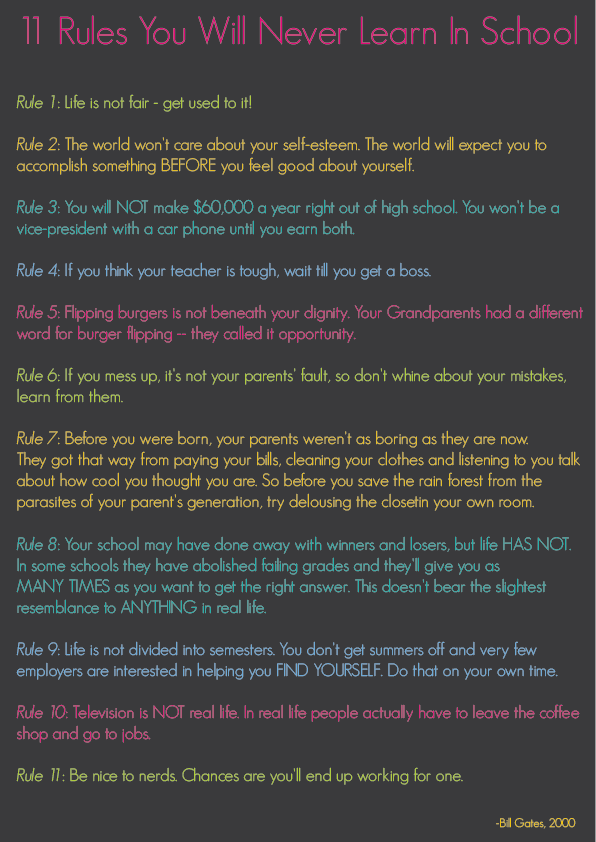


  • Rule 1: Life is not fair -- get used to it!

    Rule 2: The world won't care about your self-esteem. The world will expect you to accomplish something BEFORE you feel good about yourself.

    Rule 3: You will NOT make $60,000 a year right out of high school. You won't be a vice-president with a car phone until you earn both.

    Rule 4: If you think your teacher is tough, wait till you get a boss.

    Rule 5: Flipping burgers is not beneath your dignity. Your Grandparents had a different word for burger flipping -- they called it opportunity.

    Rule 6: If you mess up, it's not your parents' fault, so don't whine about your mistakes, learn from them.

    Rule 7: Before you were born, your parents weren't as boring as they are now. They got that way from paying your bills, cleaning your clothes and listening to you talk about how cool you thought you are. So before you save the rain forest from the parasites of your parent's generation, try delousing the closet in your own room.

    Rule 8: Your school may have done away with winners and losers, but life HAS NOT. In some schools they have abolished failing grades and they'll give you as MANY TIMES as you want to get the right answer. This doesn't bear the slightest resemblance to ANYTHING in real life.

    Rule 9: Life is not divided into semesters. You don't get summers off and very few employers are interested in helping you FIND YOURSELF. Do that on your own time.

    Rule 10: Television is NOT real life. In real life people actually have to leave the coffee shop and go to jobs.

    Rule 11: Be nice to nerds. Chances are you'll end up working for one.


    Source


  • The Writing Rules of George Orwell


    • Never use a long word where a short one will do.
    • If it is possible to cut a word out, always cut it out.
    • Never use the passive voice (e.g. "Bones are liked by dogs") where you can use the active voice ("Dogs like bones").
    • Never use jargon if you can think of an everyday equivalent.


  • Lateral thinking requires you to think outside of the usual and to push your creative spirit to the max. Unlike analytically thinking, creative thinking can't just be turned on and off, but there are ways to encourage it.


    ١]            Think Fast
    Lingering is not the way to think laterally. Inspired thoughts come from letting your stream of consciousness pour forth quickly and without reflection. Of course, apply this only to creative thinking, not to judging people or situations!

    ٢]            Avoid any form of self or other criticism
    Lateral thinking requires freedom to express anything. Criticism acts like a stopper to the flow and prevents expansion of ideas. Allow yourself and others to reach beyond the moon when thinking laterally.

    ٣]         Take care not to assume that it has all been done before.
    There is always the possibility of new thoughts, new ideas and new ways of doing things.

    ٤]            Be Non Conformist.
    Don't worry about what others will think; the moment you do, you stop thinking laterally and start self judging and potentially conforming. Allow crazy, silly, weird, unusual, outrageous, never-been-done-before ideas to pour forth un-judged. Non conformity is the concept of the moment for lateral thinking.

    ٥]            Keep a Record of your Thoughts.
    You won't know which ones are worth revisiting until later, sometimes because you're too close to it after brainstorming, sometimes because it's simply not clear what is significant until later

    ٦]         Mimic
    Don't be afraid to build on the great ideas of others. Perhaps they haven't pushed the ideas far enough yet; maybe you will. But don't be afraid to copy good ideas and make them better. (Nobody has a copyright on ideas.)

    ٧]            Avoid over analysis
    As soon as you start nitpicking too much and noticing what won't work, you've left lateral thinking and started to think analytically again. Leave details to later. Leave grand visions to later too.

    ٨]            Question repeatedly
    Is this the best there is? Is this adaptable? Is there a workaround? Be sure to ask plenty of questions, especially "what if?"

    There are several ways of defining lateral thinking, ranging from the technical to the illustrative.

    1. "You cannot dig a hole in a different place by digging the same hole deeper"
    This means that trying harder in the same direction may not be as useful as changing direction. Effort in the same direction (approach) will not necessarily succeed.

    2. "Lateral Thinking is for changing concepts and perceptions"
    With logic you start out with certain ingredients just as in playing chess you start out with given pieces. But what are those pieces? In most real life situations the pieces are not given, we just assume they are there. We assume certain perceptions, certain concepts and certain boundaries. Lateral thinking is concerned not with playing with the existing pieces but with seeking to change those very pieces. Lateral thinking is concerned with the perception part of thinking. This is where we organize the external world into the pieces we can then 'process'.

    3. "The brain as a self-organizing information system forms asymmetric patterns. In such systems there is a mathematical need for moving across patterns. The tools and processes of lateral thinking are designed to achieve such 'lateral' movement. The tools are based on an understanding of self-organizing information systems."
    This is a technical definition which depends on an understanding of self-organizing information systems.

    4. "In any self-organizing system there is a need to escape from a local optimum in order to move towards a more global optimum. The techniques of lateral thinking, such as provocation, are designed to help that change."
    This is another technical definition. It is important because it also defines the mathematical need for creativity.

    "Creative thinking is not a talent; it is a skill that can be learnt"
    Edward de Bono

    "Intelligence is something we are born with. Thinking is a skill that must be learned"

    Edward de Bono

    "Innovation distinguishes between a leader and a follower"
    Steve Jobs

    "Genius is 1% Inspiration and 99% Perspiration"
    Thomas Edison

    "The great composers did not set to work because they were inspired but became inspired because they were working"
    Ari Kiev

    "An essential aspect of creativity is not being afraid to fail"
    Edwin Land

    "Imagination is more important than knowledge. For while knowledge defines all we currently know and understand, imagination points to all we might yet discover and create"

    Albert Einstein

    "Inventions don’t come in Eureka moments: they are the consequence of experts absorbing themselves for so long in their field that they become pregnant with creative energy: deep immersion in an area of expertise"
    Michael Syed