


-
Khalil Gibran was born on 6th January, 1883, in the mountainous area of Northern Lebanon. He had a half-brother six years older than him and two younger sisters. When Gibran was eight years old, his father was imprisoned for tax evasion which resulted in the Gibans' property being confiscated. As a result, the family was homeless and lived with relatives for a while before his mother, a strong-willed woman, decided to emigrate to the US to seek a better life. There they settled in Boston's South End.Although originally placed in an ungraded class where immigrant children had to learn English from scratch, Gibran soon caught the eye of his teachers with his sketches and drawings, which eventually led to him being supported by an artistic benefactor, Fred Holland Day, which allowed Gibran to develop his talents to become a high-profile philosophical essayist, novelist, mystical poet and artist.Him most famous work and the one that he will always be remembered for was The Prophet, a book of 26 poetic essays originally published in 1923 and since translated into over 20 languages. The book became a counterculture guide in the 1960s and has remained a favorite of spiritual and New Age communities ever since.
Chapter I - The Coming of the Ship
Chapter III - Marriage
Chapter V - Giving
Chapter VI - Eating and Drinking
-
 Here are the best 10 creativity related and inspiring TED talks
(I) Julie Burstein: 4 lessons in creativity
In this talk, Burstein identifies four lessons that creative people should embrace:- Pay attention to the world around you, and be open to experiences that might change you.
. - Realize that the best work often comes out of the life experiences that are most difficult.
. - Get comfortable with the fact that pushing up against a limitation can actually help you find your voice.
. - Don’t be afraid to explore loss — be it rejection, heartbreak or death — because making beauty out of these things is so powerful.
(II) Elizabeth Gilbert: Your elusive creative genius
Gilbert reframes how we think about creativity—that rather than there being “geniuses” among us, that all of us have a bit of genius within us.
(III) David Kelley: How to build your creative confidenceHe shares why he believes it is problematic to think of society as split into the creatives and the technical-minded. Here, he shares how people who think of themselves as the latter can build up their creative muscles, as we all have them — whether we know it or not.(IV) Isaac Mizrahi on fashion and creativityMizrahi shares how his creative process heeds him to pay attention to tarot card readers and to the unique coloration of film, as well as to hop out of cabs and follow people who strike him as interesting on the streets of New York City(V) Amy Tan: Where does creativity hideAmy Tan became a writer because she found herself fascinated with one question: why do things happen the way they happen? In this talk from TED2008, Tan shares why it is so appealing to be the creator of her own universes — the one responsible for pulling strings and creating meaning.
(VI) Steven Johnson: Where good ideas come fromWhen people tell the story of an invention, they usually describe a “eureka” moment. But author Steven Johnson wonders if that might be a fallacy. In this talk from TEDGlobal 2010, Johnson looks at how breakthroughs are slow to build and usually happen in dialogue with other thinkers of the time.(VII) Janet Echelman: Taking imagination seriouslyArtist Janet Echelman is known for creating enormous, undulating sculptures out of fishnets. So how did she come up with this unconventional form? In this talk from TED2011, Echelman explains that she found her voice when her paints went missing on a trip to a fishing village in India, and she was forced to work in a new medium.(VIII) Kirby Ferguson: Embrace the remixIn this talk from TEDGlobal 2012, Kirby Ferguson unleashes a bold idea: that maybe creative types shouldn’t be so concerned with originality. As Ferguson sees it, creativity is all about copying, transforming and remixing things that already exist. In Ferguson’s eye, everything is a remix.(IX) Malcolm McLaren: Authentic creativity vs. karaoke cultureThe manager of the Sex Pistols, Malcolm McLaren helped shape the counterculture of the late ‘70s and ‘80s. In his final speech before passing away in 2010, McLaren shares his fears about what he calls “karaoke culture,” where success is about mimicry rather than emotional honesty. Because as McLaren sees it, no one should be shielded from the messy, difficult struggle of creating something new.
(X) Tim Brown: Tales of creativity and playWhat is the difference between being a designer and just playing around? Not as much as most people think, says Tim Brown, the CEO of IDEO. At Serious Play 2008, Brown shares how building a successful firm was as easy as giving employees a place to experiment without fear of being judged — just like kids do on a daily basis.
- Pay attention to the world around you, and be open to experiences that might change you.
-
Life Without Limits: Inspiration for a Ridiculously Good Life
Nick Vujicic is a man who was born without his 4 limbs. Yet this is not a story of a man who is needy, but one who is so full of joy and hope that he himself brings light to people around him.
Nick Vujicic is a man without limbs. Yet Nick is not someone who is depressed, bitter or upset about what has happened in his life. In fact, he’s someone full of joy and happiness in his life.This is a great testimony for all of us to learn about making the best that we have. Nick Vujicic once said that the greatest disabilities that all of us have are not physical; guilt and fear are what cripple men the most.And with that life philosophy, he goes on to live his life with purpose. Now, he goes all over the world speaking in huge events and conventions.If there was anyone that can complain about not being ‘entitled’ enough in life, it would be Nick Vujicic. But he chose to take what he had and maximized all of it. We must have the same attitude to life as well. Instead of constantly thinking about what we don’t have, perhaps it is time to start thinking about what we have. People who constantly think about what is lacking in their lives will come out bitter, depressed or angry. These actually describes a lot of people out there in our world, and they end up never doing anything great in their lives.When we start focusing on what we have in our lives, we will maximize our potential by continually exercising our talent. We think about our core competencies and we focus our energies to hone ourselves till eventually, we become experts at it.Nick Vujicic is truly a real life inspiration to all who see and hear him
-
Stop and Listen to Your Gut By David Allen Ibsen
The mind can assert anything, and pretend it has proved it. My beliefs I test on my body, on my intuitional consciousness, and when I get a response there, then I accept.—D.H. Lawrence
The author D.H. Lawrence was right. We can rationalize our way into virtually any decision, but it is our gut instincts that often hold the answers to true success.We’re taught in school about logical, well thought-out, and fact-based decision-making. There’s usually a “right” and “wrong” answer to a college test question. These thought-out decision-making habits are then reinforced in business as we are trained in the “right way” to talk to a customer, and the “wrong way” to present in front of a large group of people. We’re taught that “The customer is always right” and to “listen to your boss.”Yes, thinking things out is a practiced habit of decision-making. It is a back-and-forth analysis, a system that can be skewed towards one decision or another if we apply our own bias to the analysis.However, skewed analysis often happens when we over-think a decision, or when we start the decision-making process with a predisposed desired outcome.Consider the habit of developing lists of “pros” and “cons,” a commonly regarded “foolproof” decision-making process. Maybe you created a list of eight reasons in the “pro” column to use your credit card to pay for that new camera you want to buy. and only four in the “con” column. Where’s my Visa card?Instinct, on the other hand is an untaught ability. It may deliver a more reliable and unbiased result.A research study from Leeds University Business School published in the British Journal of Psychology in 2008 applied some science to the idea that "gut feelings" are in fact not in our gut at all, but in fact are a specific brain activity.According to the researchers, intuition represents one of the ways our brains store, process, and retrieve information. The researchers analyzed a wide range of previous studies and concluded that intuition is the brain drawing on past experiences and current external cues to make a decision; the process is so rapid that the reaction is subconscious. It is part of the brain that allows us to make fast, instinctual decisions.In essence, when we “go with our gut,” the brain is not giving us a chance to talk ourselves out of a decision.Consider when gut decisions come to us: when we react immediately and instinctually under pressure, or when we set aside the hard thought of evaluating pros and cons. We just let our body and our brain free itself up to allow instinct to take over. Instinct is intelligence incapable of self-consciousness.Consider the example of a long-time client of mine. Eileen is a serial entrepreneur—the founder of four technology start-up companies over the years. She makes decisions every day that can make or break her company.Admittedly, Eileen has made her share of good and bad decisions. One day she decided to analyze the good and bad choices, examining how she came to these decisions. She realized that when she made decisions by listening to her gut, she had a far better success rate than when she followed a strictly logic-based decision process. Going with her gut worked when she had to make split-second decisions, as well as when she allowed her gut to marinate on an idea for a while, and catch up to logic. She began to lead with her gut, and she saw an improved success rate in her decision-making process. She has created a well-bred instinct that meets reason halfway. As she puts it, “Calculation never made a hero.”Follow your instincts. That's where true wisdom manifests itself. —Oprah WinfreySo the next time you are faced with a decision under pressure, take a second or two — and only a second or two — to evaluate whether you can hear your instincts telling you what to do, pulling you towards one path or another. They may be quietly whispering to you, but they are always worth listening to. Stop, take a breath, and filter out the rational noise. Hear that beautiful voice: your inner thoughts giving you true wisdom.Call it a “gut check.”Author David Allen Ibsen is CEO of Five Meetings Before Lunch, a market-driven business strategy company, with over 25 years experience helping emerging companies and established brands build effective strategies and programs when they’re ready to launch, pivot or grow. He also is Editor-in-Chief of the online magazine FIVE THôT at the intersection of creativity and commerce.
Source -
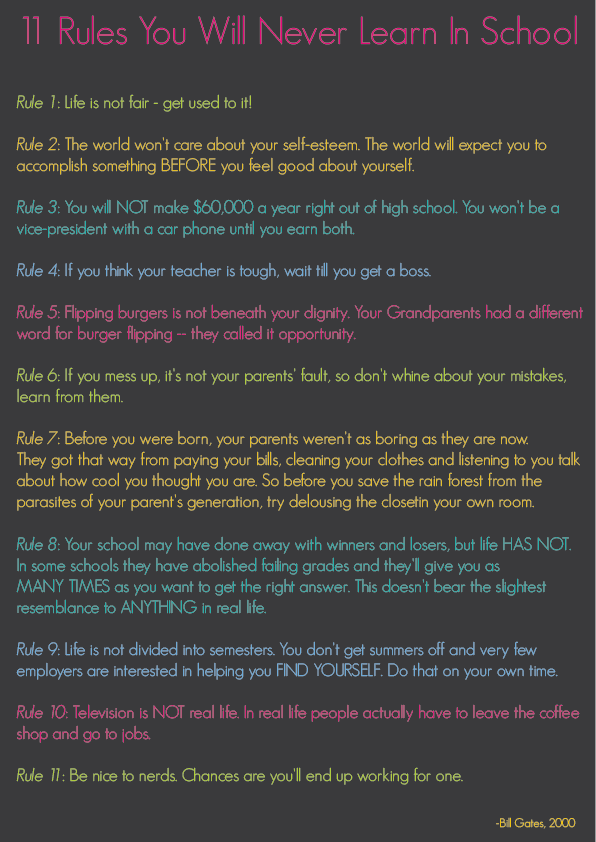
Rule 1: Life is not fair -- get used to it!Rule 2: The world won't care about your self-esteem. The world will expect you to accomplish something BEFORE you feel good about yourself.Rule 3: You will NOT make $60,000 a year right out of high school. You won't be a vice-president with a car phone until you earn both.Rule 4: If you think your teacher is tough, wait till you get a boss.Rule 5: Flipping burgers is not beneath your dignity. Your Grandparents had a different word for burger flipping -- they called it opportunity.Rule 6: If you mess up, it's not your parents' fault, so don't whine about your mistakes, learn from them.Rule 7: Before you were born, your parents weren't as boring as they are now. They got that way from paying your bills, cleaning your clothes and listening to you talk about how cool you thought you are. So before you save the rain forest from the parasites of your parent's generation, try delousing the closet in your own room.Rule 8: Your school may have done away with winners and losers, but life HAS NOT. In some schools they have abolished failing grades and they'll give you as MANY TIMES as you want to get the right answer. This doesn't bear the slightest resemblance to ANYTHING in real life.Rule 9: Life is not divided into semesters. You don't get summers off and very few employers are interested in helping you FIND YOURSELF. Do that on your own time.Rule 10: Television is NOT real life. In real life people actually have to leave the coffee shop and go to jobs.Rule 11: Be nice to nerds. Chances are you'll end up working for one.
Source
-
Daring to Dream the ImpossibleWe've All Been in Positions Where Our Sense of Safety Felt Like It Was at RiskSometimes It Made Sense to Reach For What We've Yearned, Despite the Odds
It Can Be Tough to Push in The Face of Fear and DiscouragementIt's Powerful to Create the Version of Your Life YOU Want rather than giving inSucceeding Entails What Everyone Else May Have Told YouIt's Living in the moment, knowing the Past's Memory and Future's UnknownIt's About Surrendering to The Unknown and Relinquishing WorriesSometimes It's About Surrendering to a Higher Power and Daring to Simply DreamLiving in the Impossible can be Inspiring and Life-ChangingBut It Also Requires Turning Your "I can't" into "I Will"Always Turn In the Direction of Your Passion and Truth, Despite the Odds
Showing posts with label Change. Show all posts
Showing posts with label Change. Show all posts




Subscribe to:
Posts (Atom)


